Control the maze. Control the motion.
00
problem
Traditional maze games rely on direct manual interaction, limiting the exploration of how digital systems can influence physical movement. The challenge was to design a system that bridges digital input and mechanical output, enabling a user to control a physical environment through an electronic interface while maintaining intuitive and responsive interaction.
solution
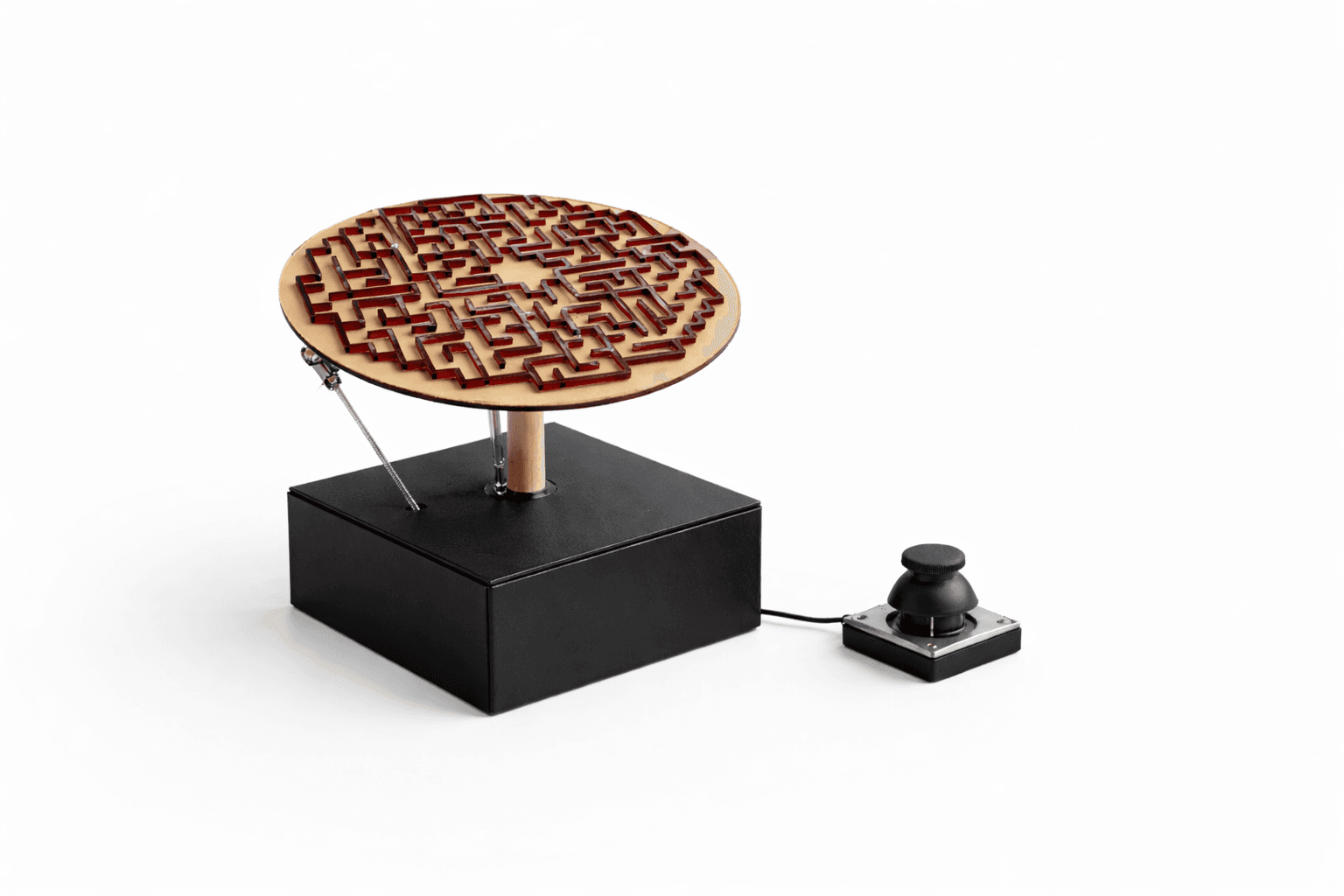
MAZEIT is an interactive maze system that translates joystick input into controlled physical motion. A joystick module captures user input and sends analog signals to an Arduino microcontroller. The Arduino processes this data and actuates two servo motors, which tilt the maze platform along the X and Y axes using a ball-and-socket joint mechanism. This allows the user to guide a ball through the maze with precision, creating a seamless connection between input, computation, and physical response.
The Idea
MAZEIT began as a curiosity during my introduction to physical computing.
While exploring systems that interact with the physical world, I came across a self-balancing surface plate capable of stabilizing a ball. This led to a simple but compelling question:
If a system can balance a ball, can it also control where the ball goes?
This thought became the foundation of MAZEIT.
From Balance to Control
The initial concept focused on building a platform that could tilt along two axes using servo motors.
The system was designed around a ball-and-socket joint, allowing free movement while maintaining a stable center. By controlling the tilt through servo actuation, the surface could dynamically change orientation.
As the mechanism started working, the idea evolved instead of just balancing the ball, the system could be used to navigate it intentionally.
This transition transformed the project from a technical experiment into an interactive game.
Interaction
MAZEIT is controlled through a joystick interface, making the experience intuitive and tactile.
• Moving the joystick directly tilts the maze
• The platform responds in real time
• The ball moves based on gravity and user control
This creates a strong feedback loop between hand movement and physical response, making the interaction feel immediate and engaging.
System Components
The project integrates electronics, mechanics, and fabrication.
Key components include:
• Arduino Uno microcontroller
• Two servo motors for axis control
• Analog joystick module
• Breadboard and jumper wiring
• Laser-cut maze platform
• MDF base structure
• Acrylic maze walls
• Ball-and-socket mechanical joint
Fabrication
The maze structure was created using a combination of MDF and acrylic.
The maze base was laser cut from MDF, while the maze walls were fabricated using acrylic to create the labyrinth pathways.
The central support structure and ball-and-socket joint allow the platform to tilt smoothly while maintaining stability.
The electronics were prototyped using breadboards and mounted within a protective base enclosure.
Outcome
The final prototype successfully demonstrates how digital input can control mechanical movement in real time.
The joystick-controlled maze creates an engaging physical interaction where players must carefully guide the ball through the labyrinth.
The project combines electronics, mechanical systems, and interaction design into a single interactive product prototype.
Future Development
The next iteration of the project explores the idea of creating a 3D tangible maze environment.
Future improvements include:
• Interchangeable maze modules with different difficulty levels
• Three-dimensional maze environments inspired by games such as Mekorama and Red Ball
• Improved mechanical precision and smoother actuation
• A fully integrated enclosure for electronics and mechanisms
The long-term vision is to develop the concept into a modular interactive tabletop game platform.
year
2024
timeframe
14 days
tools
ArduinoIDE , Fusion 360 , Illustrator
category
Physical Computing
see also